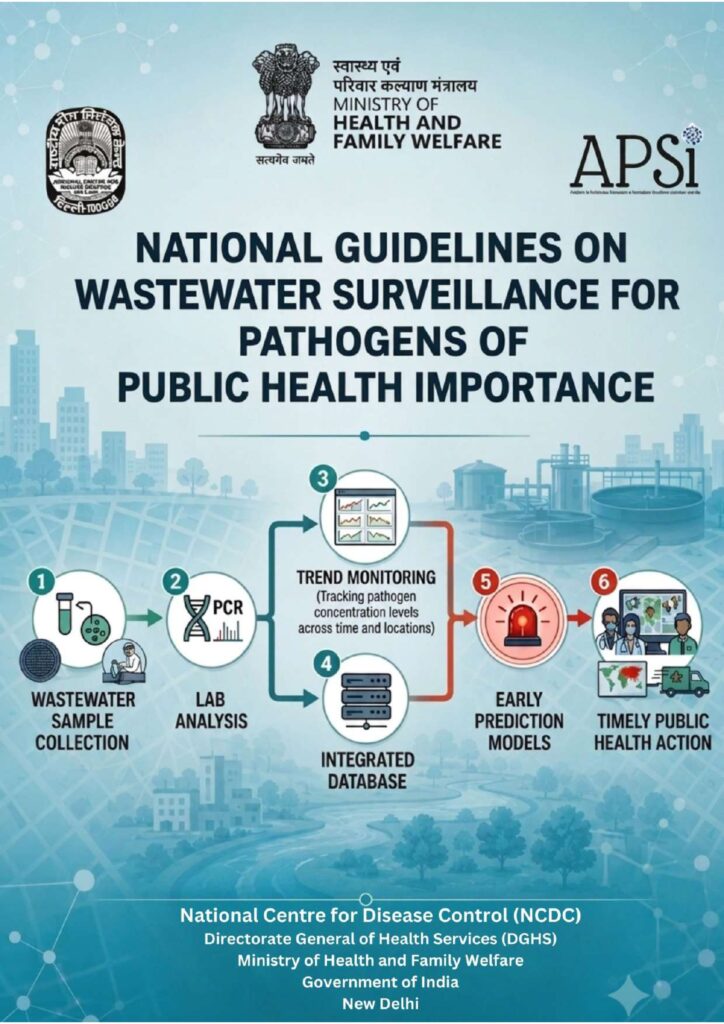
The National Centre for Disease Control (NCDC), under the Directorate General of Health Services (DGHS) and the Ministry of Health and Family Welfare (MoHFW), Government of India, has released the National Guidelines on Wastewater Surveillance for Pathogens of Public Health Importance.
The guidelines establish a standardised framework for advancing Wastewater-Based Epidemiology (WBE) across India, providing an important foundation for strengthening pathogen surveillance, early warning systems and public health preparedness within the One Health framework.
At the Tata Institute for Genetics and Society (TIGS), our engagement with wastewater-based epidemiology began during the COVID-19 pandemic, with a focus on tracking SARS-CoV-2 through environmental surveillance. Over the past five years, TIGS has progressively built substantial scientific, technical and institutional capacity in this area, extending its work beyond SARS-CoV-2 to the surveillance of other pathogens and antimicrobial resistance (AMR).
Our contribution to the development of these national guidelines reflects this sustained engagement and the collective experience gained through research, field implementation and institutional collaboration.
The release of these guidelines marks an important milestone in translating the experience and evidence generated through wastewater surveillance into a national framework. It is a crucial step towards system strengthening, enabling more coordinated, standardised and scalable approaches to public health surveillance in India.
Access the guidelines document here
We acknowledge the leadership of MoHFW, DGHS and NCDC, and recognise the contributions of all collaborating institutions in advancing this important national initiative.
Institutions involved
- Ministry of Health and Family Welfare (MoHFW), Directorate General of Health Services (DGHS) & National Centre for Disease Control (NCDC)
- Integrated Disease Surveillance Programme (IDSP)
- Alliance for Pathogen Surveillance Innovations (APSI)-India
- Tata Institute for Genetics and Society (TIGS), Bengaluru
- CSIR-Centre for Cellular and Molecular Biology (CSIR-CCMB), Hyderabad
- TIFR-National Centre for Biological Sciences (TIFR-NCBS), Bengaluru
- Ashoka University, Sonepat
- CSIR-National Chemical Laboratory(CSIR-NCL) Pune
- Pasteur Institute, Shillong