What if the antibiotics we rely on today stop working tomorrow?
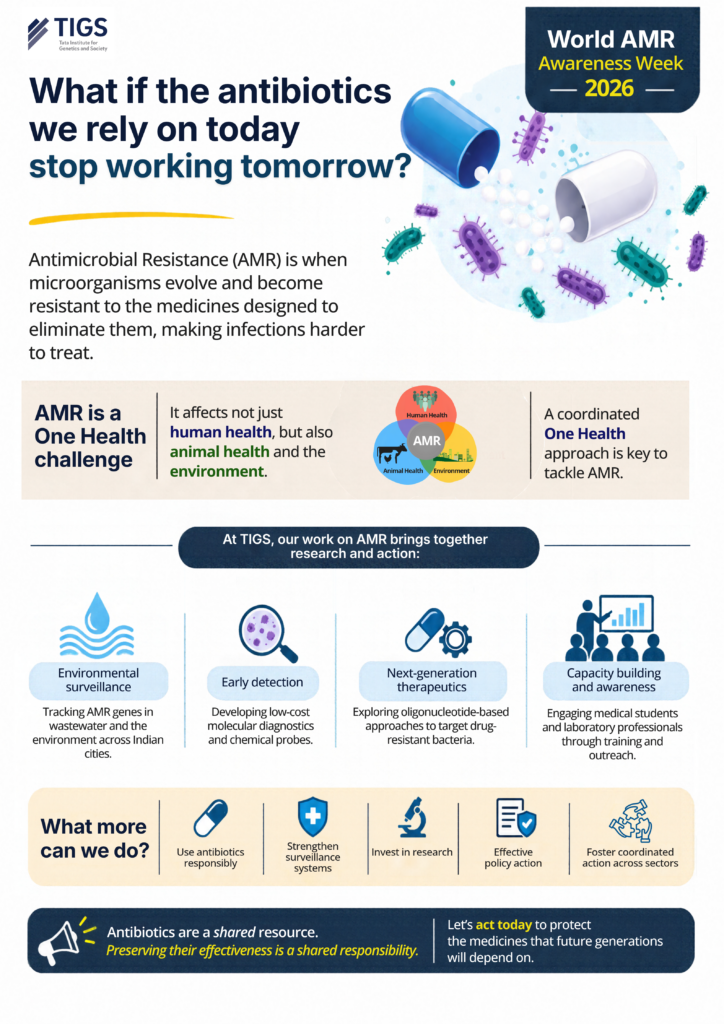
Antimicrobial Resistance (AMR) is one of the most pressing public health challenges of our time. As microorganisms evolve and develop resistance to the medicines designed to eliminate them, infections become increasingly difficult to treat, threatening decades of progress in modern medicine.
But AMR is not just a hospital or human health problem. It is a complex, interconnected challenge spanning human health, animal health and the environment. Addressing it requires a strong One Health approach, backed by science, surveillance, innovation and collective action.
At the Tata Institute for Genetics and Society (TIGS), our work on AMR brings together multiple dimensions of research and action:
🔹 Environmental surveillance: Leveraging wastewater and environmental surveillance across Indian cities to understand the presence and distribution of antimicrobial resistance genes, including their potential transmission through treated wastewater reused for irrigation.
🔹 Early detection: Developing low-cost molecular diagnostics and chemical probes to enable faster identification of drug-resistant infections.
🔹 Next-generation therapeutics: Exploring oligonucleotide-based therapeutic approaches that could selectively target drug-resistant bacteria or restore their susceptibility to existing antibiotics.
🔹 Capacity building and awareness: Engaging medical students and laboratory professionals through training and awareness initiatives to strengthen the response to AMR.
As we observe World AMR Awareness Week 2026, the message is clear: scientific advances alone cannot address this challenge. Responsible antibiotic use, stronger surveillance systems, sustained research investments, effective policies and coordinated action across sectors are essential.
Antibiotics are a shared resource. Preserving their effectiveness is a shared responsibility.
Let’s act today to protect the medicines that future generations will depend on.