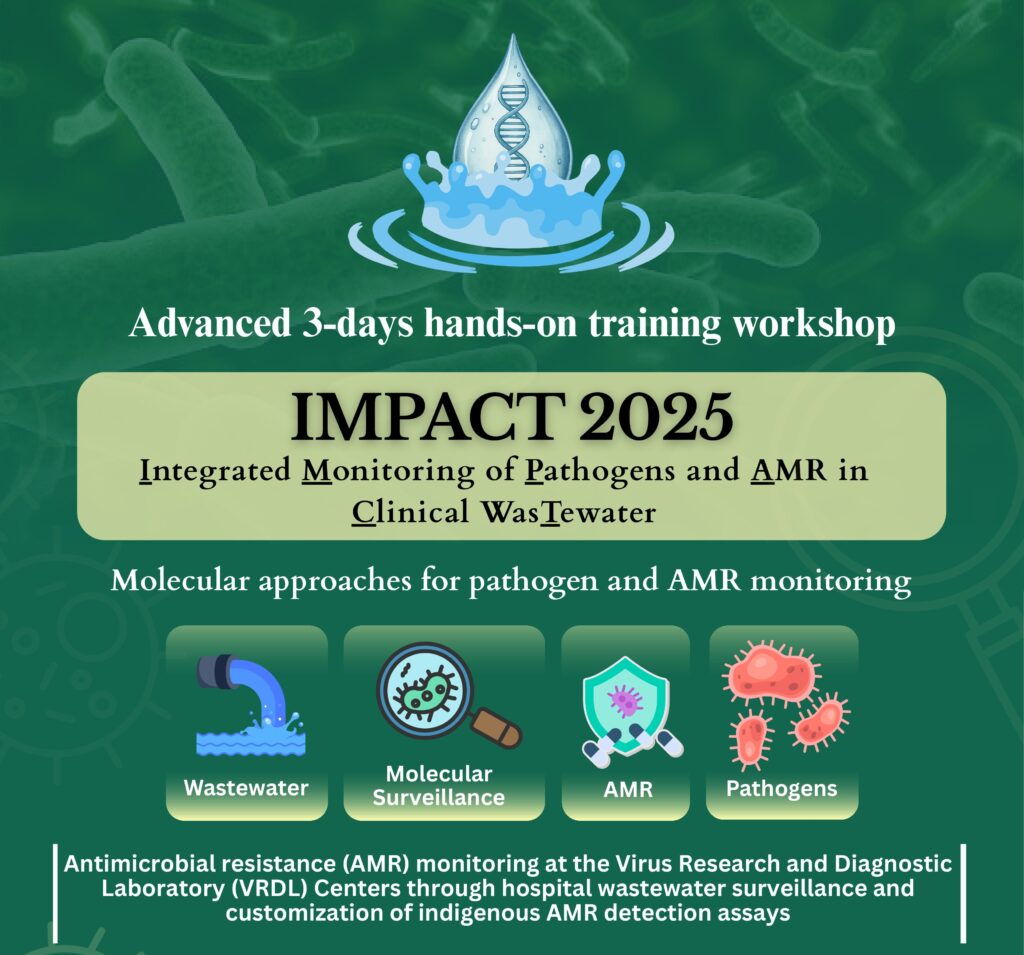
We are pleased to close the year with the successful completion of the final workshops of the IMPACT 2025 series (Integrated Monitoring of Pathogens and AMR from Clinical Wastewater), with Cohort 4 (3–5 Nov 2025) and Cohort 5 (15–17 Dec 2025).
With this, we conclude a year-long, five-cohort capacity-building initiative under the TIGS–ICMR partnership, training teams from 57 ICMR-VRDLs across India in the end-to-end workflow of wastewater-based pathogen and AMR surveillance.
The series was inaugurated by Dr. Rakesh Mishra (Director, TIGS) and Dr. L S Shashidhara (Director, NCBS), who highlighted the importance of surveillance capacity and pandemic preparedness. We were fortunate to have the presence of ICMR representatives Dr. Nivedita Gupta, Dr. Jitendra Narayan, and Dr. Anoop Velayudhan, who collectively emphasized the role of wastewater surveillance in addressing AMR and emerging infectious diseases.
The workshops brought together perspectives from science, policy, and practice. Vishwanath S (Biome Environmental Solutions Pvt – India) shared insights on wastewater systems and on-ground sewage infrastructure realities; Dr Tanweer Hussain (IISc) discussed antibiotic–target interactions; and Dr. Sweta Raghavan (Advisor – AMR Action Plan, Government of Karnataka) provided perspectives on AMR action plans and public health policy.
Dr. Shivranjani Moharir led sessions on wastewater metagenomics and targeted qPCR approaches, emphasizing decentralized, data-driven public health action plans. The workshops combined field exposure which included a visit to the Jakkur Sewage Treatment Plant along with hands-on laboratory training, metagenomic data interpretation led by Apoorva Venkatesh and Sreelekshmi R S. Sessions on metagenomic data interpretation were delivered by Manas Madhukar, followed by a session on strategies for scaling and integrating clinical wastewater surveillance across the VRDL network by Dr. Siddharth Bhatia
We were encouraged by reflections from Dr. Shalini Kunhikannan, Ph.D. (NIMHANS), a participant from the first cohort, who shared real-world learnings and data generated through this initiative. The program also included guided lab tours covering BSL-2 facilities, the insectary, and next-generation sequencing infrastructure at the BLiSC, helping participants understand biosafety practices and sequencing pipelines. Interactive learning sessions led by Dr. Sufia Sadaf (Ph.D.) (NCBS-TIFR) further strengthened peer learning across VRDL teams.
We thank all VRDL participants, Indian Council of Medical Research (ICMR) and our knowledge partners APSI-India, National Centre for Biological Sciences (NCBS), and Biome Environmental Solutions Pvt – India for their continued support.
As IMPACT 2025 concludes, the focus now shifts from training to sustained surveillance and actionable public health data, advancing a coordinated, pan-India framework for wastewater-based AMR and pathogen surveillance.